The world poses a danger to the Church today. Unfortunately, the Church and some of its leaders, who should be at the forefront of correcting this situation, are themselves leading the way. Yet, Jesus has assured us that the gates of hell shall not prevail against His Church.
As He declared:
“This is the rock on which I will put together my church, a church so expansive with energy that not even the gates of hell will be able to keep it out.” (Matthew 16:18, MSG)
Let me make it clear that I am not one of those who delight in criticizing church leaders, notwithstanding the damage some have continued to inflict on the Body of Christ. I strongly believe that our response should include fervent prayers for God’s intervention, repentance, and restoration.
This is why I have deliberately chosen not to mention anyone’s name in this article. My focus is on correcting erroneous teachings that have misled and kept many unsuspecting believers in spiritual bondage. Besides, I do not have complete confidence in every report circulated on social media today.
The Scriptures tell us that the love of money is a root of all kinds of evil (1 Timothy 6:10). However, what we are witnessing in some quarters of the Church today goes beyond the love of money. It is increasingly becoming a form of bondage to Mammon.
Some church leaders have resorted to questionable practices and distorted biblical teachings to raise money for their ministries. They appear so consumed by the pursuit of wealth that they stop at nothing to persuade, pressure, and sometimes coerce people into giving. Worse still, the extravagant display of wealth by some of these leaders has become a source of embarrassment to the Body of Christ.
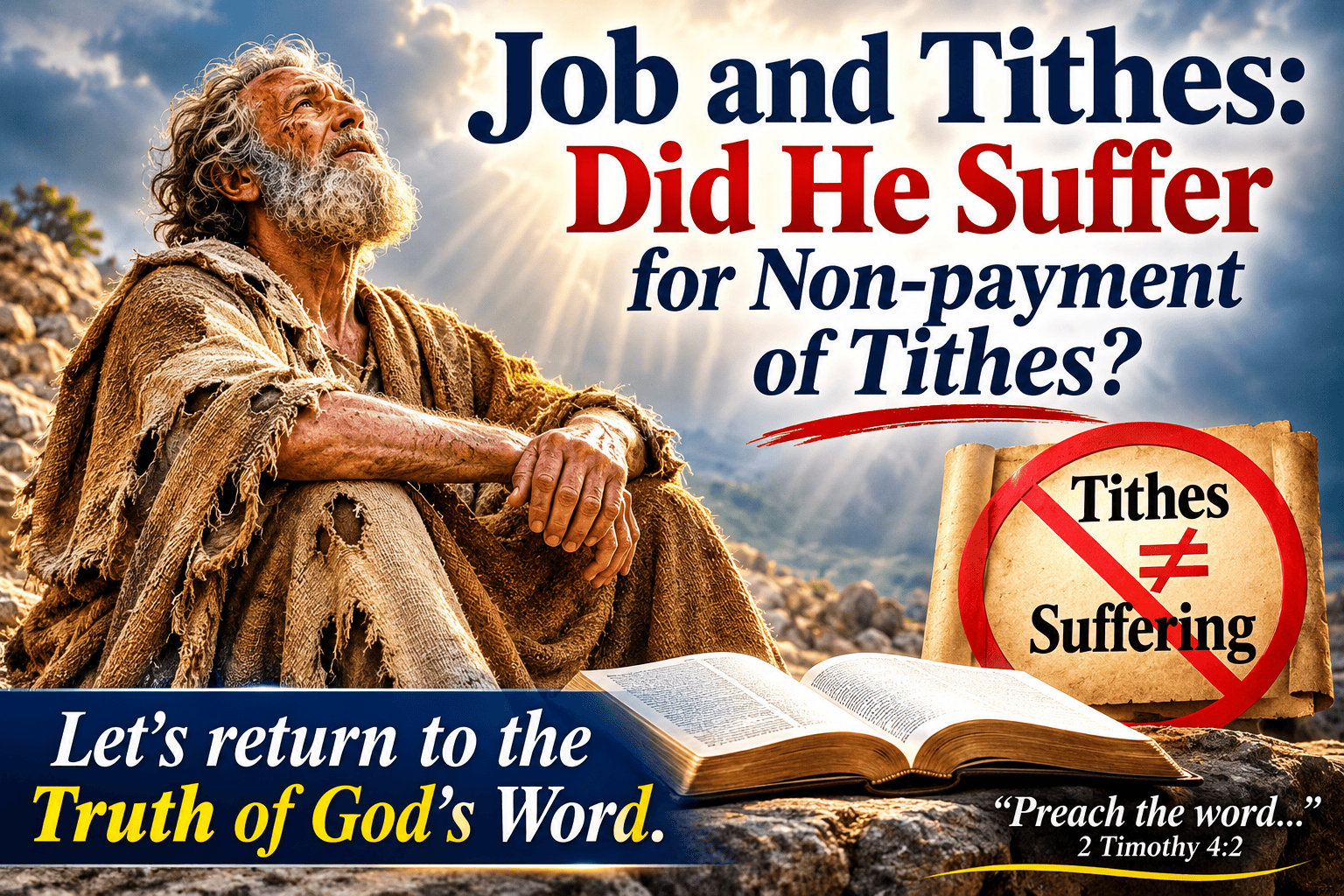
Recently, a pastor was reportedly quoted on social media as saying that Job suffered the calamities inflicted by Satan because he failed to pay tithes.
I consider this assertion not only biblically unfounded and misleading but also an unfortunate misrepresentation of God’s character and His dealings with Job.
Let us consider what the Scriptures actually reveal about Job.
1. Job’s story predates the establishment of the Mosaic Law on tithing.
The events surrounding Job are generally understood to have occurred in the patriarchal period, before the giving of the Mosaic Law. The first explicit biblical account of someone giving a tenth is found in Genesis 14:18–20, when Abraham gave Melchizedek, the priest of God Most High, a tenth of the spoils of war.
There is no biblical account suggesting that Job was under any obligation to pay tithes or that his suffering had anything to do with non-payment of tithes.
2. God was pleased with Job’s character and conduct.
The Bible introduces Job as a blameless and upright man who feared God and shunned evil (Job 1:1).
In fact, God Himself testified to Job’s exceptional character, asking Satan:
“Have you considered My servant Job, that there is none like him on the earth, a blameless and upright man, one who fears God and shuns evil?” (Job 1:8, NKJV).
Could there be a clearer testimony of God’s approval of a man’s character?
3. Satan, not God, initiated the challenge against Job’s integrity.
Satan questioned Job’s loyalty to God, suggesting that his faithfulness was merely a product of God’s protection and blessings. He argued that Job would curse God if everything he possessed were taken away.
Satan therefore challenged God to remove the protection around Job and allow him to experience suffering, believing that Job would abandon his faith.
God permitted Satan to test Job, but placed clear limits on what he could do. Satan was first permitted to attack Job’s possessions and family, but not his person. Subsequently, God permitted an attack on Job’s health, but his life was spared (Job 1:9–12; 2:4–6).
4. Job remained faithful to God despite his unbearable suffering.
Job suffered tremendous losses, physical affliction, emotional anguish, and intense pressure from those closest to him, including his wife and friends.
Yet, despite his circumstances, he refused to abandon his faith in God. Although he questioned and struggled to understand his suffering, he did not turn away from God.
The Bible records that in all these things, Job did not sin with his lips (Job 2:10). Even when his friends wrongly accused him and attempted to explain his suffering through their own misguided assumptions, God eventually rebuked them for not speaking rightly about Him as Job had done (Job 42:7).
If God Himself testified to Job’s righteousness, and the conclusion of the story affirmed his faithfulness, on what biblical grounds can anyone attribute his suffering to failure to pay tithes?
My Appeal to Church Leaders
I sincerely appeal to church leaders and preachers to stop desecrating the pulpit with teachings that misrepresent the Word of God and exploit the vulnerability of believers.
The pulpit is a sacred trust. It should be used to proclaim the truth of God’s Word, lead people to Christ, build their faith, and prepare them for eternity.
Paul’s admonition to Timothy remains relevant today:
“Preach the word! Be ready in season and out of season. Convince, rebuke, exhort, with all longsuffering and teaching.” (2 Timothy 4:2, NKJV).
Our Lord Jesus Christ is coming again. Whatever material possessions and worldly treasures we accumulate here will eventually pass away. We must therefore return to the things that matter most: our relationship with God, obedience to His Word, and the salvation of souls.
Let us heed the admonition of John:
“Don’t love the world’s ways. Don’t love the world’s goods. Love of the world squeezes out love for the Father. Practically everything that goes on in the world—wanting your own way, wanting everything for yourself, wanting to appear important—has nothing to do with the Father. It just isolates you from him. The world and all its wanting, wanting, wanting is on the way out—but whoever does what God wants is set for eternity.” (1 John 2:15–17, MSG).
The Church must return to the Word of God. The pulpit must never become an instrument of financial exploitation, and the Gospel must never be reduced to a fundraising scheme. May God have mercy on His Church and restore the ministry’s integrity. Amen.
Michael Jolayemi is the Author of:
- Saving America: The war we can’t ignore
- Sheltered Through the Storm: The Travails and Ultimate Triumph of the Church
- The Mysteries of God, the Origin We Don’t Know, the Eternity We Should Believe
- My New Book: Defying Death – How to Live and Not Die. Please get your copy and let me know what you think