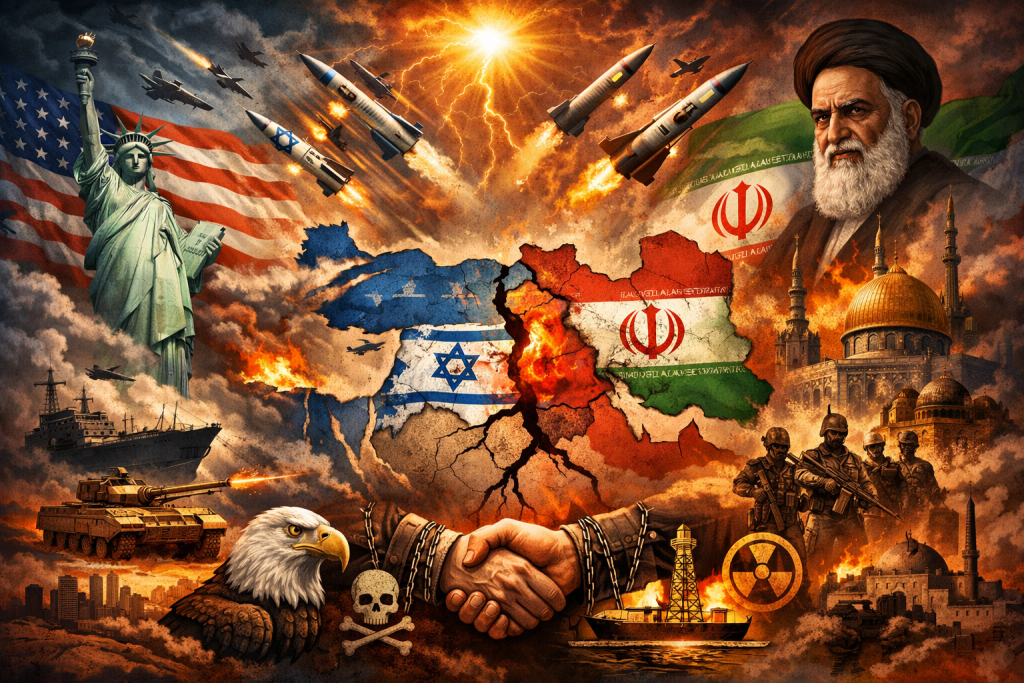
Public reactions to the USA/Israeli–Iran conflict reflect a wide spectrum of perspectives shaped by differing levels of understanding. Much of the discourse centers on economic instability, energy insecurity, and the potential for social disruption. While these concerns are valid, meaningful engagement is often hindered by an unwillingness to consider alternative viewpoints. Too frequently, individual and national interests overshadow the pursuit of a balanced, collective good. A more constructive approach would require integrating diverse perspectives while setting aside narrow self-interest for the broader benefit of the global community.
There is no denying that the global economy has been significantly affected. Rising energy costs, fluctuations in gas prices, and general market instability have been evident since the onset of the conflict. Experts have warned that a prolonged crisis could lead to a substantial surge in oil prices. The anxiety felt by many is rooted in the desire to preserve economic security and maintain a reasonable standard of living, entirely legitimate concerns.
However, beyond these practical considerations lies a more complex dimension of political bias. Some opposition to the conflict appears less about its consequences and more about personal or ideological opposition to those managing the situation, particularly the President of the United States, Donald J. Trump. In certain cases, political actors seem more inclined to undermine leadership than to support national stability. This dynamic creates a troubling paradox in which the perceived success of an individual leader becomes entangled with the perceived success or failure of the nation itself.
It is important to acknowledge that the desire for peace and stability is universal. Those tasked with national defense are not exempt from this aspiration. War, by its very nature, is undesirable. Yet, the reality remains that the world continues to grapple with forces that make conflict difficult to avoid. Over the past several decades, global tensions have intensified, and in my view, a significant contributing factor has been the policies and ideological posture of the Islamic Revolutionary Government in Iran.
Many nations in the Middle East, including Saudi Arabia, Kuwait, Iraq, and the United Arab Emirates, have expressed varying degrees of concern or, at times, remained cautious in their responses regarding Iran’s expanding regional influence. These tensions are particularly acute for Israel, which is often viewed as a primary strategic target. This perception is reinforced by repeated hostile rhetoric from officials in Tehran, including calls such as “death to Israel” or “death to America.” At the same time, it is important to recognize the realities faced by ordinary Iranian citizens, many of whom desire the same stability, opportunity, and normalcy enjoyed by people in other parts of the world.
Since 1979, when the authoritarian monarchy of Shah Mohammad Reza Pahlavi was overthrown and replaced with an Islamic theocracy under Ayatollah Ruhollah Khomeini, global dynamics have shifted in ways that were not fully understood at the time. The revolution’s goal, as I see it, was to oppose anything contrary to its interpretation of Islamic doctrine. Over time, Iran has extended its influence across various parts of the world, pursuing what critics describe as an agenda of religious expansion through force, demanding conformity or facing severe consequences. This, in my view, marked the beginning of a broader rise in global terrorism.
Despite its vast resources, the Iranian government has focused less on developing its people and more on expanding its ideological reach, possibly toward a unified Islamic global order. Its opposition to the West is not merely geographical, but ideological, seeing the West as representing beliefs and values contrary to its own. In this perspective, those who hold differing religious views, including other Muslims, are often regarded as adversaries. Beyond perceiving people of differing views as adversaries, there is an even more troubling tendency to classify them as infidels who must be actively pursued and eliminated.
Groups aligned with Iran’s government are believed to pursue two main objectives: exporting loyalists to Western countries to influence and reshape cultural systems, and expanding ideological indoctrination through educational and social structures. In many places, some argue that Western institutions, schools, and universities are increasingly exposed to such influences. European culture, in particular, is seen by critics as being under pressure, while political leadership struggles to respond effectively.
As I wrote in my book published in 2012, the United States remains one of the primary obstacles to Islamic jihadist ambitions. This, I believe, is one reason the Islamic Republic of Iran has pursued a nuclear program: to become powerful and untouchable by any nation, including the USA. The fear is that, once fully empowered, such a regime could seek to eliminate Israel, challenge America, and expand its ideology globally. Regrettably, leadership within global institutions like the United Nations has not provided sufficiently effective solutions to the growing instability in the global political order; they are often perceived as exhibiting concerning bias.
How did Trump come into the picture? While some may not believe in God, I do. I believe that God intervenes in human affairs at the appropriate time. In my view, Donald J. Trump has been prepared over the years for a purpose, whether he fully realizes it or not. I have written in past articles that Trump is, in my opinion, an instrument of God, used to confront certain forms of ungodliness in the world, including those influenced or led by the United States itself.
The first year of Donald Trump’s return to office has witnessed significant shifts in both domestic and international policy, including the reversal of certain practices viewed as contrary to moral or traditional values, such as gender transition procedures. It has also been marked by a more assertive stance toward Iran’s nuclear ambitions. Supporters argue that, without such actions, the near future of the global order could have faced serious risks.
Therefore, one should not be overly persuaded by the many attacks against Trump and his administration. Such opposition is expected, but it can only go so far. Ultimately, I believe that God’s purposes will prevail.
Let those who have ears hear what the Lord says to the church.
Michael Jolayemi is the Author of:
- Saving America: The war we can’t ignore
- Sheltered Through the Storm: The Travails and Ultimate Triumph of the Church
- The Mysteries of God, the Origin We Don’t Know, the Eternity We Should Believe
Please be on the lookout for my forthcoming book, “Defying Death: How to Live and Not Die”, a powerful exploration of life, faith, and victory over death.